
Haryana | Special Crime & Justice Report | Data period: 2016–2025
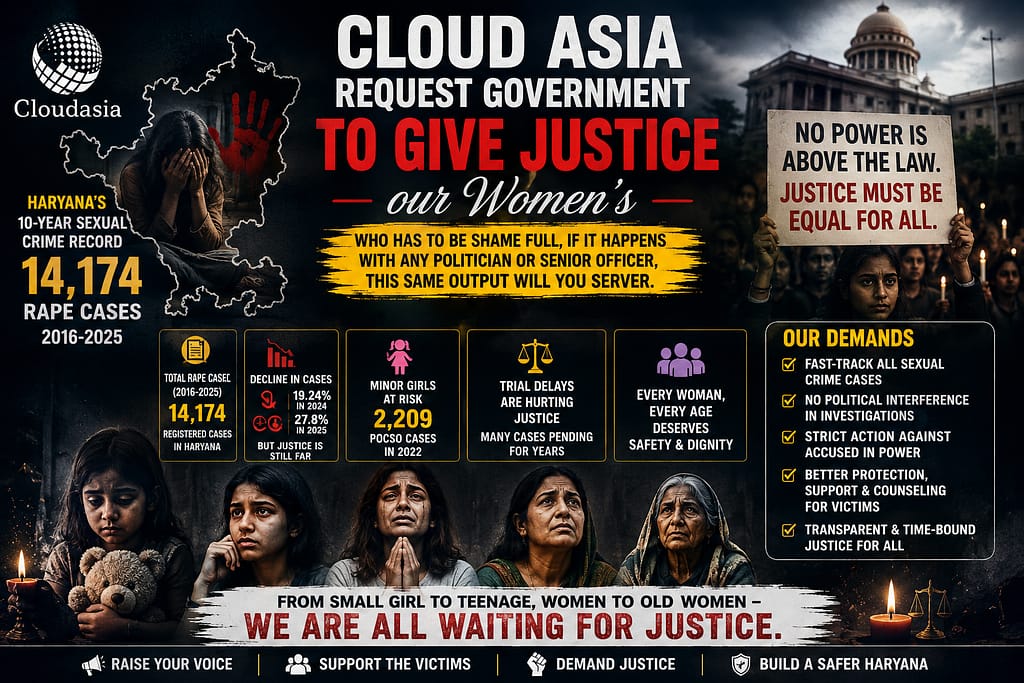
Haryana has recorded at least 14,174 registered rape cases between 2016 and 2025, according to NCRB and Haryana Police data compiled for this report. The figures show that although reported rape cases have fallen sharply in the last two years, the state continues to face a serious challenge involving sexual violence, crimes against children and delays in the criminal-justice process.
The figures are based primarily on official government/NCRB and Haryana Police records rather than social-media posts. News portals and individual court reports have been used only to supplement case-level information.
Rape cases in Haryana: 2016–2025
Year
Registered rape cases
2016–1,187
2017–1,099
2018–1,296
2019–1,480
2020–1,373
2021–1,716
2022–1,787
2023–1,772
2024–1,431
2025–1,033
Total= 14,174
NCRB records confirm 1,187 cases in 2016 and 1,099 in 2017. Haryana subsequently reached 1,787 cases in 2022, while the 2023 NCRB figure was 1,772. Haryana Police reported 1,431 cases in 2024 and 1,033 in 2025.
The recent decline
The latest figures show a significant reduction. Rape cases fell 19.24% in 2024, from 1,772 to 1,431, and then fell another 27.8% in 2025, to 1,033.
Haryana Police says the overall number of crimes against women fell from 13,945 in 2024 to 8,723 in 2025.
However, a fall in registered cases should not automatically be interpreted as proof that every form of sexual violence has disappeared. Registration is influenced by reporting, policing, social pressure and access to the justice system.
Sexual harassment: why the numbers need careful interpretation
“Sexual harassment” is not one single NCRB category covering every form of harassment.
Haryana’s 2021 state statistical data separately recorded offences under Sections 354A–354D IPC, classified as sexual harassment, along with assault, stalking and related offences.
For 2025, Haryana Police recorded:
- 1,128 cases under the combined “Molestation/Sexual Harassment” category
- 150 cases specifically classified as sexual harassment
- 375 cases of assault intended to outrage modesty
- 196 cases involving intent to disrobe
- 344 stalking cases
- 63 voyeurism cases
- 321 cases of insult to the modesty of women
Separately, Haryana Police reported 2,265 eve-teasing cases in 2023 and 1,431 in 2024, a decline of about 36.8%.
Therefore, these categories should not simply be added together to create a “10-year sexual harassment total”; doing so would mix legally different offences and could result in double counting.
Minor girls: a particularly serious concern
The data also shows the significant presence of children among sexual-crime victims.
For Haryana, the official 2021–22 data recorded 2,209 POCSO cases in 2022. The government data also showed 1,787 rape cases in the state that year.
The proportion of sexual crimes involving girls within crimes against children has fluctuated considerably. Haryana’s SDG report, based on NCRB data, records the proportion at 32.91% in 2016, 25.67% in 2017, 37.77% in 2018, 38.60% in 2019, 40.06% in 2020, 37.72% in 2021 and 34.08% in 2022.
Cases in which a minor’s body was recovered after alleged sexual assault
There have been extremely disturbing individual cases, but no official 10-year Haryana statistic classifies rape cases according to whether the victim’s body was found unclothed, partially unclothed, on a street, in a field, beside a road or in another location.
One documented case involved a 15-year-old girl whose body was recovered from a canal in Jind district in January 2018. A later report stated that the body was found partially unclothed and that the case was subsequently reopened by a POCSO fast-track court in 2024
Another Haryana court record concerns a 2018 case involving a three-year-old child whose body was reported as being found in an unclothed condition near vacant shops. The case record describes allegations of sexual assault and murder; such allegations must be distinguished from a final conviction when reporting.
These cases illustrate why the issue attracts public outrage, but they cannot legitimately be converted into a statewide numerical trend without a systematic police/court dataset.
How many offenders actually received justice?
This is where the statistics become more complicated.
NCRB’s rape database records registered cases, chargesheeted cases, completed trials and convictions, but a conviction recorded in a particular year does not necessarily relate to a rape case registered in that same year. Court cases can remain pending for years.
For example, official data shows the following Haryana rape-case convictions:
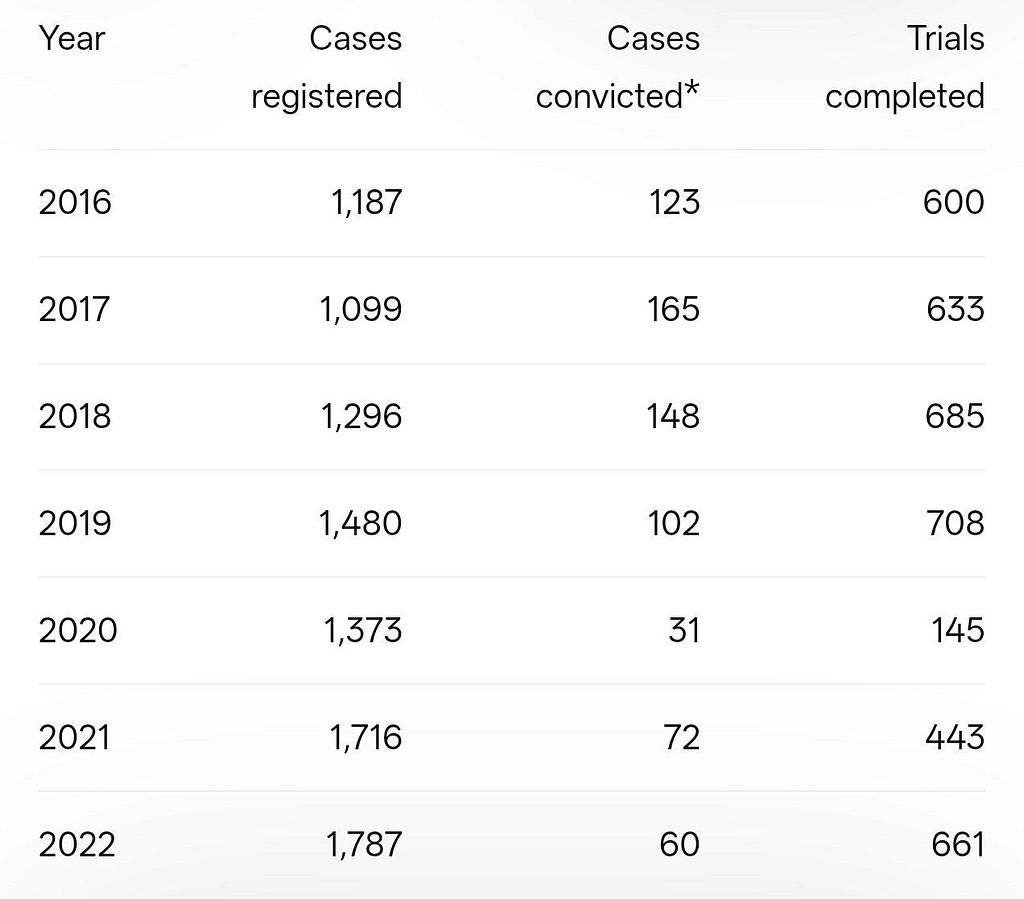
Total convictions recorded in these seven years: 701.
These are cases in which trials resulted in conviction during that year, not 701 convictions from the 14,174 cases registered during 2016–2025.
This distinction is critical. Saying “only 701 out of 14,174 cases were punished” would be statistically incorrect because thousands of cases were still under investigation or trial, while convictions in a given year may relate to older FIRs.
Chargesheeting and conviction remain major concerns
The 2023 NCRB figures highlighted a serious justice gap. Haryana’s chargesheeting rate for crimes against women was reported at only 56%, compared with a national average of 77.9%, while the conviction rate was reported at 13.6%.
At the national level, NCRB’s 2022 data showed a 27.4% conviction rate for rape cases, demonstrating the wider problem of a large number of cases remaining unresolved or ending without conviction.
Death penalty and life imprisonment
There is no verified public 2016–2025 Haryana government table that gives a complete statewide total of all rape offenders sentenced specifically to death or life imprisonment.
However, individual cases demonstrate that Haryana courts have imposed the death penalty in exceptionally serious rape-murder cases involving children.
Panipat — 2022
A fast-track court in Panipat sentenced two men to death for the rape and murder of a 12-year-old girl. The case involved an offence committed in 2018. The report described it as the first double capital punishment in a POCSO case in Haryana.
Fatehabad — 2025
In April 2025, a Haryana district court sentenced two convicts to death for the rape and murder of a 3½-year-old girl. The trial was completed within approximately one year and the court classified the offence as a “rarest of the rare” case.
Important: A trial-court death sentence is not necessarily the final punishment. It is subject to confirmation by the High Court and can subsequently be challenged before higher courts.
Recent Haryana cases also demonstrate why sentencing figures should not be presented simplistically. In January 2026, the Punjab and Haryana High Court set aside a death sentence in a rape-murder case involving a five-year-old girl because of procedural defects in the trial.
Why does justice take so long?
Several structural factors contribute to delay:
1. Investigation and evidence collection
Sexual-offence cases often depend on medical evidence, DNA, forensic material, electronic evidence and witness testimony. Any failure or delay can weaken the prosecution.
2. Low/slow chargesheeting
The 2023 NCRB figures placed Haryana’s crime-against-women chargesheeting rate significantly below the national average.
3. Large court pendency
Haryana courts had around 2.58 lakh IPC cases pending trial at the end of 2022, illustrating the broader judicial burden.
4. Witnesses and repeated hearings
Witness availability, adjournments, forensic reports and procedural requirements can extend trials.
5. Appeals after conviction
Even after a conviction, appeals can continue through the High Court and Supreme Court, particularly in death-penalty cases.
6. Procedural safeguards
Speed cannot replace a fair trial. The recent Haryana rape-murder cases in which death sentences were overturned show that courts must ensure that evidence is properly presented and the accused receives a fair opportunity to defend himself.
Fast-track courts: progress, but pendency remains
The Union government established Fast Track Special Courts and exclusive POCSO courts to accelerate rape and child-sexual-offence trials.
As of December 2023, Haryana had 16 functional Fast Track Special Courts, including 12 exclusive POCSO courts, which had cumulatively disposed of 5,342 cases under the scheme.
The existence of these courts is an important step, but the continuing pendency shows that court capacity, investigation quality and case management remain essential.
What the 10-year data tells us
The Haryana picture is neither simply “crime is increasing” nor “the problem has been solved.”
The major findings are:
- 14,174 rape cases were registered in Haryana during 2016–2025.
- The highest annual figure in this period was 1,787 in 2022.
- Cases fell to 1,431 in 2024 and 1,033 in 2025.
- Haryana recorded 2,209 POCSO cases in 2022, demonstrating the scale of crimes involving children.
- The state recorded serious concerns over chargesheeting and conviction in earlier NCRB data.
- 701 rape-case convictions were recorded during 2016–2022, but these cannot be directly compared with the 14,174 FIRs because court outcomes and FIR years do not correspond one-to-one.
- Death sentences have been imposed in exceptionally serious child rape-murder cases, including two convicts in Panipat in 2022 and two in Fatehabad in 2025, but there is no reliable consolidated 10-year statewide figure for death or life sentences.
- There is no official statewide database counting cases where victims’ bodies were found unclothed or partially unclothed, so social-media claims should not be presented as an official statistic.
Conclusion:
The numbers show a recent decline in reported rape and crimes against women in Haryana, but the justice system faces a different challenge: registration of an FIR is only the beginning of justice.
The real measure of public safety must include the quality of investigation, timely chargesheets, forensic capacity, protection of victims and witnesses, completion of trials, convictions based on reliable evidence, compensation and the final outcome of appeals.
For minor victims, the issue is even more urgent. Individual cases in Haryana involving rape and murder of children—and the recovery of victims’ bodies in disturbing circumstances—have repeatedly exposed the devastating consequences of sexual violence.
The state’s recent decline in registered cases is encouraging, but the long-term test will be whether Haryana can combine prevention, rapid investigation and genuinely time-bound trials with legally sound convictions.
Data note: This report deliberately does not use Facebook/social-media posts as numerical evidence. Social media can help identify reported incidents, but official NCRB, Haryana Police, Parliament and court records are required before presenting a number as a statewide statistic.
About The Author