
Gaza After October 7: Three Years of War, Death and a World That Could Not Stop It
By CloudAsia News
Editor’s note: This article distinguishes reported casualty figures from independently verified figures and does not equate the actions of governments, armies or armed groups with the beliefs of entire populations. The phrase “Israelis have lost their humanity” is therefore not used as a factual conclusion; the conduct of governments and armed groups should be judged on evidence and international law.
Nearly three years of devastation
The Gaza war began after the Hamas-led attack on southern Israel on 7 October 2023, when about 1,200 people in Israel were killed and 251 people were taken hostage, according to widely cited Israeli and international figures. Israel responded by launching a massive military campaign in the Gaza Strip, saying its objectives were to destroy Hamas, recover the hostages and prevent another October 7 attack.
Almost three years later, the human cost has become extraordinary.
According to figures reported by Gaza’s Ministry of Health and reproduced by the UN Office for the Coordination of Humanitarian Affairs (OCHA), at least 71,439 Palestinians had been reported killed by mid-January 2026, with more than 171,000 injured. By 24 June 2026, OCHA reported 73,041 Palestinian fatalities and 173,402 injuries. The UN cautions that figures supplied by the Gaza Ministry of Health that have not yet been independently verified are attributed to their source.
The number represents more than a statistic. Behind every figure is a person: a child, parent, doctor, teacher, journalist, aid worker or elderly civilian.
And the death toll does not capture people who may die later from untreated injuries, hunger, disease, destroyed medical infrastructure or the long-term consequences of war.
How did this war begin?
The immediate trigger was the Hamas-led attack of 7 October 2023.
Hamas and other Palestinian armed groups crossed into southern Israel, attacked communities and military positions, killed civilians and soldiers, and abducted hundreds of people. The UN’s independent Commission of Inquiry has found evidence of serious violations and war crimes committed by Palestinian armed groups during the attack.
Israel declared war and began an extensive bombing campaign across Gaza.
The Israeli government argued that Hamas had embedded military infrastructure inside densely populated areas and that destroying Hamas’s military capabilities was necessary for Israel’s security.
But Gaza is one of the world’s most densely populated territories. As the Israeli campaign expanded, residential buildings, refugee camps, hospitals, schools and other civilian infrastructure were repeatedly damaged or destroyed.
The conflict therefore quickly moved from an Israeli military response to a humanitarian catastrophe.
The first phase: October–December 2023
The opening months saw some of the heaviest Israeli bombardment.
Israel ordered residents in northern Gaza to evacuate south. Large numbers of Palestinians fled their homes, often with nowhere safe to go.
At the same time, Israel imposed severe restrictions on the movement of people and goods into Gaza. Electricity, fuel, water, food and medical supplies became increasingly scarce.
Hospitals were overwhelmed.
Israel said Hamas used hospitals and civilian areas for military purposes. Hamas denied using civilians as human shields. International investigations have continued to examine allegations against both sides.
By the end of 2023, thousands of Palestinians had been killed and much of Gaza’s urban landscape had been devastated.
2024: Rafah, Khan Younis and a widening catastrophe
The war continued into 2024 despite growing international pressure.
Israeli forces expanded ground operations into Khan Younis and later toward Rafah, where more than a million displaced Palestinians had sought refuge.
The prospect of a major Rafah offensive alarmed humanitarian organisations and governments around the world because of the enormous civilian population concentrated there.
The International Court of Justice (ICJ), hearing South Africa’s case alleging violations of the Genocide Convention, issued provisional measures in January 2024 and subsequently issued additional orders concerning Gaza. The ICJ proceedings are distinct from the International Criminal Court’s criminal investigation and should not be confused with a final judgment establishing genocide.
The war nevertheless continued.
In May 2024, the Israeli military entered parts of Rafah.
The fighting, displacement and restrictions on humanitarian access continued to produce civilian casualties and severe shortages.
The international legal response
The war did not go unnoticed by international institutions.
The International Court of Justice ordered provisional measures in the case brought by South Africa. These orders were legally significant, although the Court had not, at that stage, issued a final ruling determining whether Israel had committed genocide.
The International Criminal Court also pursued individual criminal responsibility.
In November 2024, ICC judges issued arrest warrants for Israeli Prime Minister Benjamin Netanyahu and former Defence Minister Yoav Gallant concerning alleged war crimes and crimes against humanity. The Court’s action concerns individual criminal responsibility and is not a finding that all Israelis, or even all members of the Israeli government or military, are guilty.
The ICC process also concerns Palestinian armed-group leaders and allegations arising from the 7 October attack and the subsequent war.
The message from international law was clear: the identity of the perpetrator does not determine whether an act is legal.
2025: The war enters another phase
The conflict continued into 2025, including a major re-escalation in March after an earlier ceasefire period.
OCHA reported that between 7 October 2023 and 16 July 2025, Gaza’s Ministry of Health had reported 58,573 Palestinian deaths. By 30 July 2025, that figure had risen to 60,138.
The figures continued climbing.
The destruction was no longer limited to individual buildings. Gaza’s housing, hospitals, schools, roads, water systems and economic infrastructure had suffered enormous damage.
The result was a population in which displacement became almost permanent.
2026: A ceasefire, but not an end to suffering
Even after the October 2025 ceasefire, violence did not completely disappear.
OCHA reported that by January 2026, Gaza’s Ministry of Health had recorded 71,439 Palestinian deaths since 7 October 2023.
By June 2026, the reported Palestinian death toll had reached 73,041, according to OCHA’s reported-impact snapshot.
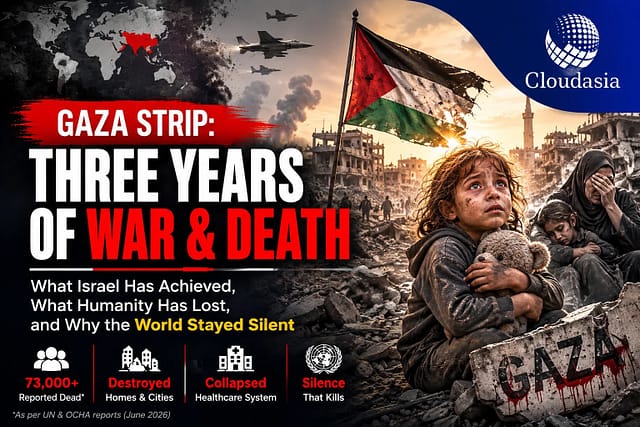
Recent reports show that Israeli strikes have continued despite the ceasefire framework. Reuters reported two Palestinian deaths in Israeli strikes on 13 August 2026, while other reporting has documented continuing violence and severe humanitarian conditions.
In other words, the ceasefire has reduced the scale of fighting but has not erased the consequences of nearly three years of war.
What has Israel achieved?
This is perhaps the most difficult question.
Israel has undoubtedly damaged Hamas’s military infrastructure and killed or captured large numbers of Hamas members. It has also recovered some hostages and substantially changed the military and political landscape of Gaza.
But whether those achievements justify the enormous civilian cost is a political, moral and legal question—not something that can be answered simply by counting military targets.
Israel’s stated strategic objective has been to ensure that Hamas can never again carry out an attack like 7 October.
Yet Hamas has not simply disappeared.
At the same time, Israel faces an internationally damaged reputation, continuing legal proceedings, enormous diplomatic pressure and a deeply traumatised Palestinian population.
Gaza itself has been devastated.
So the uncomfortable question remains:
If the war was intended to create long-term security, can security be achieved by destroying the physical and social foundations of an entire society without creating another generation of anger and violence?
Has humanity disappeared in Israel?
It is understandable that people watching the destruction of Gaza ask this question.
But it would be wrong to conclude that an entire nationality has lost its humanity.
There are Israelis who oppose the war. There are Israeli families demanding the return of hostages. There are Israeli human-rights organisations documenting abuses. There are also Israelis who strongly support the military campaign.
Likewise, Palestinians are not synonymous with Hamas.
Hamas is an armed political organisation. Gaza’s civilians are a population.
The same principle applies in reverse: Hamas’s crimes against Israeli civilians cannot make every Palestinian responsible, just as actions by the Israeli government cannot make every Israeli responsible for those actions.
Humanity must be measured by how we treat civilians—even when those civilians belong to the other side.
Why didn’t the United Nations stop it?
This question exposes one of the biggest weaknesses of the international system.
The UN can investigate, condemn, document, provide humanitarian assistance and adopt resolutions.
But it does not possess a world army capable of simply entering Gaza and stopping a war.
The UN Security Council is particularly important because its five permanent members—the United States, Russia, China, Britain and France—possess veto power.
Several ceasefire initiatives failed because of disagreements among major powers.
The United States repeatedly used its veto or threatened to do so on Gaza-related Security Council resolutions, although Washington also supported some later ceasefire initiatives. In February 2024, for example, the Security Council failed to adopt an immediate humanitarian ceasefire resolution because of a US veto.
A later US veto was described by UN sources as the fifth American veto of a Gaza ceasefire draft resolution.
This demonstrates a fundamental problem:
International law may exist, but enforcement often depends on political power.
Why didn’t the world intervene militarily?
Because intervening militarily against Israel would risk creating a much larger regional war.
Israel is a heavily armed state with strong military capabilities and close strategic relationships with major Western powers, particularly the United States.
Western governments have also argued that Israel has a legitimate right to defend its population following the 7 October attack.
Critics respond that the right to self-defence does not mean unlimited military action and that civilian protection and international humanitarian law must still apply.
That debate has become one of the central controversies of the war.
The deeper failure
Perhaps the greatest failure is not that the world did nothing.
The world did something.
There were UN resolutions, diplomatic negotiations, humanitarian operations, international investigations, court proceedings, protests, sanctions in some countries and repeated calls for ceasefires.
The failure was that these measures were not powerful or coordinated enough to stop the destruction quickly.
International institutions could document deaths.
They could issue orders.
They could investigate alleged war crimes.
But they struggled to compel powerful actors to comply.
That gap between law and enforcement is at the heart of the Gaza tragedy.
What did the war achieve for Palestinians?
For ordinary Palestinians, the answer is devastating.
Hundreds of thousands have been killed or injured, displaced from their homes or left without functioning homes. Families have been separated. Children have grown up amid bombing, hunger and fear.
Even people who survived the attacks face a future in which homes, schools, hospitals, businesses and public infrastructure may have to be rebuilt.
The psychological damage could last for generations.
And what did 7 October achieve for Palestinians?
The Hamas attack did not bring Palestinian statehood.
It did not end the occupation.
It did not produce lasting security.
Instead, it triggered a war that devastated Gaza and caused enormous suffering for both Palestinians and Israelis.
The attack itself involved deliberate attacks on civilians and hostage-taking—acts that international investigators have condemned.
A political cause does not make attacks on civilians legitimate.
The question the world must now answer
After nearly three years, the central question is no longer simply who won the latest battle.
It is:
How many more people must die before the political leaders accept that military force alone cannot solve the Israeli-Palestinian conflict?
Israel needs security.
Palestinians need freedom, safety, dignity and political rights.
Israeli civilians deserve to live without fear of massacre or hostage-taking.
Palestinian civilians deserve to live without bombardment, forced displacement and deprivation.
These demands are not mutually exclusive.
The tragedy is that the international community has spent decades treating them as if they were.
Conclusion: Gaza is a warning to the world
The Gaza war is not only a story about Israel and Palestine.
It is a test of the international system.
If international law applies only when the accused is weak, it loses credibility.
If civilian lives matter only when they belong to an ally, the language of human rights becomes hollow.
And if the world can watch tens of thousands of civilians die while governments argue over diplomacy, vetoes and strategic interests, then the question is not only what happened in Gaza.
The question is what kind of international order the world is willing to accept afterward.
The exact death toll will continue to change as bodies are identified and people who died indirectly from war-related conditions are counted. But one fact is already beyond dispute: Gaza has suffered a level of death and destruction that will remain one of the defining humanitarian catastrophes of this generation.
The final judgment—political, historical and, where applicable, legal—will take years.
For the families who lost loved ones, however, history is not waiting.
They are already living with the consequences.
About The Author