By CloudAsia News Desk | Gurugram
Gurugram is once again facing an old monsoon problem with a new number attached to it.
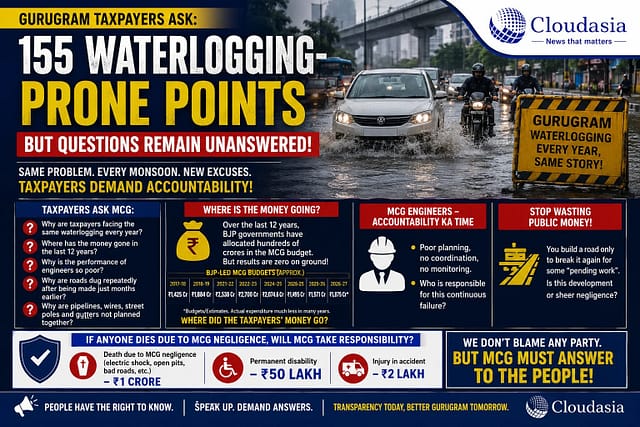
The Municipal Corporation of Gurugram (MCG) has identified 155 waterlogging-prone locations across the city.

The identification of these locations is important. But for the residents of Gurugram, one question is even more important:
If the government already knows where waterlogging happens, why does the same problem keep returning every monsoon?
This is no longer simply a question of rain.
It is a question of planning, engineering, coordination, expenditure and accountability.
155 locations identified — but what happens next?
Identifying 155 vulnerable locations should be the beginning of a permanent solution, not the end of a survey.
Residents pay property tax, municipal charges, electricity-related taxes and other charges directly or indirectly connected with civic services. They expect basic infrastructure in return — roads, drainage, sewerage, street lighting and safe public spaces.
Yet every monsoon, many residents find themselves asking the same questions:
Why are roads flooded?
Why do drains overflow?
Why are roads repeatedly dug up?
Why are newly constructed roads opened again within months for pipelines, cables, sewerage or other works?
And perhaps the biggest question:
Where is the integrated infrastructure planning?
Why aren’t roads, drains, pipelines, cables and streetlights planned together?
A common complaint from residents is that a road is constructed or repaired, only to be dug up again later for another utility project.
One department constructs the road.
Another department needs to lay a pipeline.
Another needs to repair a sewer line.
Another needs to install underground cables.
Streetlights need electrical work.
Then the road is dug up again.
Eventually, taxpayers pay for the road more than once.
This raises a fundamental question for MCG and other agencies involved in Gurugram’s infrastructure:
Why isn’t there a single coordinated utility plan before a road is constructed?
Why can’t water pipelines, sewer lines, storm-water drains, electrical cables, telecom infrastructure and streetlight requirements be mapped first and then the road be constructed once?
If this coordination already exists, residents deserve to know why repeated road cutting continues.
The taxpayer’s question: Where is the money going?
This question should not be interpreted as an allegation of corruption.
It is a demand for transparency.
MCG’s budgets have run into thousands of crores over the years. During the BJP-led MCG period, reported expenditure estimates included approximately ₹1,425 crore for 2017–18, ₹1,884 crore for 2018–19, ₹2,538 crore for 2021–22, ₹2,700 crore for 2022–23, ₹2,074.6 crore for 2023–24, ₹1,495 crore for 2024–25, ₹1,571 crore for 2025–26 and ₹1,875 crore for 2026–27. These are budget/expenditure estimates for the respective years and should not be treated as actual spending totals or as one single cumulative “BJP expenditure” figure.
The numbers themselves raise a legitimate public question.
How much money was actually spent?
Where was it spent?
Which contractor received each work order?
What was the original estimate?
What was the final cost?
Was the work completed on time?
Was it inspected after completion?
Who certified the quality?
These are not political questions.
They are public-accountability questions.
MCG’s own numbers deserve scrutiny
The concern becomes even more significant when budget allocation is compared with actual utilisation.
For 2023–24, MCG had estimated expenditure of ₹2,074.6 crore and revenue of ₹2,802.6 crore. However, reporting later showed that actual expenditure was around ₹1,050 crore and actual revenue around ₹1,100 crore.
In another example, MCG’s 2026–27 budget provides for ₹1,875 crore of expenditure and ₹1,918 crore of estimated income. Yet development expenditure remains almost unchanged at around ₹400 crore.
This creates another question:
Is the problem a shortage of money — or a shortage of effective planning and execution?
Because if money is allocated but projects do not produce durable results, residents have every right to ask for a project-by-project performance report.
What about the engineering department?
Gurugram is one of India’s fastest-growing urban centres.
It has world-class corporate offices, multinational companies, luxury residential developments and millions of people travelling through the city.
So why does basic infrastructure sometimes appear to be planned in pieces?
The question should not be:
“Why are government engineers bad?”
The more constructive question is:
“What accountability system exists for engineering decisions that repeatedly fail?”
If a drainage design fails every monsoon, who reviews the design?
If a road repeatedly develops potholes, who examines the construction quality?
If a newly repaired road is dug up again, who approved the sequencing of the works?
If a streetlight pole, electrical cable, drain or sewer creates a safety hazard, who inspected it?
And if the same location appears on the waterlogging list year after year, what measurable action has been taken to permanently eliminate the problem?
We need a “One Road, One Plan” policy
Gurugram needs a fundamental change in infrastructure planning.
Before a major road is constructed or reconstructed, authorities should publicly map:
Storm-water drainage
Sewerage
Water pipelines
Electricity cables
Telecom cables
Streetlight infrastructure
Footpaths
Road levels and gradients
Future utility requirements
Only after this coordination should the final road surface be constructed.
And once a road is completed, repeated digging should require a strong justification, public disclosure and responsibility for restoration.
Why should taxpayers pay twice for the same road?
What happens if someone dies?
This is perhaps the most serious question.
Open excavations, exposed electrical infrastructure, flooded roads, missing safety barriers, unsafe streetlights and poorly restored roads can create genuine risks to residents.
If a person loses their life because of demonstrable negligence in a civic work, residents need clarity:
Who is legally responsible?
What investigation is triggered?
Who is accountable for the contractor’s work?
Who is accountable for inspection and certification?
Does MCG have a defined compensation and liability framework for such cases?
Some citizens may demand compensation of ₹1 crore for a death, ₹50 lakh for permanent disability and ₹2 lakh for an accident.
Those figures should be treated as public demands, not existing legal entitlements. Actual compensation would depend on applicable law, negligence findings, insurance/contractual provisions and decisions of the competent authority or court.
But the larger question remains:
If citizens are expected to pay their taxes on time, shouldn’t the government also be expected to accept responsibility when its proven negligence causes serious harm?
This is not about BJP vs Congress
Let us be very clear.
This article is not an attack on BJP.
It is not an endorsement of Congress or any other political party.
The same questions should be asked of whoever is responsible for civic administration.
Political parties come and go.
Governments change.
Commissioners change.
Engineers change.
Contractors change.
But the taxpayer remains.
And the taxpayer continues to pay.
Therefore, accountability cannot change with the government.
MCG should publish a public performance report
Instead of merely announcing that 155 locations have been identified, MCG should publish a detailed public dashboard showing:
1. All 155 waterlogging locations
2. The responsible department/agency for each location
3. The cause of waterlogging
4. The proposed permanent solution
5. Estimated project cost
6. Contractor/agency responsible
7. Work-order value
8. Project start date
9. Expected completion date
10. Current status
11. Amount already spent
12. Photographs before and after the work
13. Independent quality inspection
14. Whether the location remained waterlogging-free after intervention
That would transform a government announcement into measurable accountability.
Gurugram’s taxpayers deserve answers
Gurugram does not need another monsoon promise.
It needs permanent solutions.
The identification of 155 waterlogging-prone locations gives the administration an opportunity to demonstrate that government data can actually lead to government action.
But residents should not have to wait for another monsoon to ask the same questions.
Where did the money go?
Why are roads being repeatedly dug up?
Why aren’t utilities planned together?
Who is responsible when engineering decisions fail?
Who monitors contractors?
Who checks the quality of completed work?
And if a citizen suffers serious injury or death because of proven civic negligence, who will stand accountable?
These are not anti-government questions.
They are democratic questions.
Gurugram’s taxpayers want to know.
MCG — speak up.
Show the data.
Show the expenditure.
Show the work.
Show the results.
And most importantly — show the people that their money is being used responsibly.
Because a world-class city cannot be built with world-class buildings and third-class civic accountability.
About The Author